CNC Machining Explained The Heart of Hydraulic Component Production
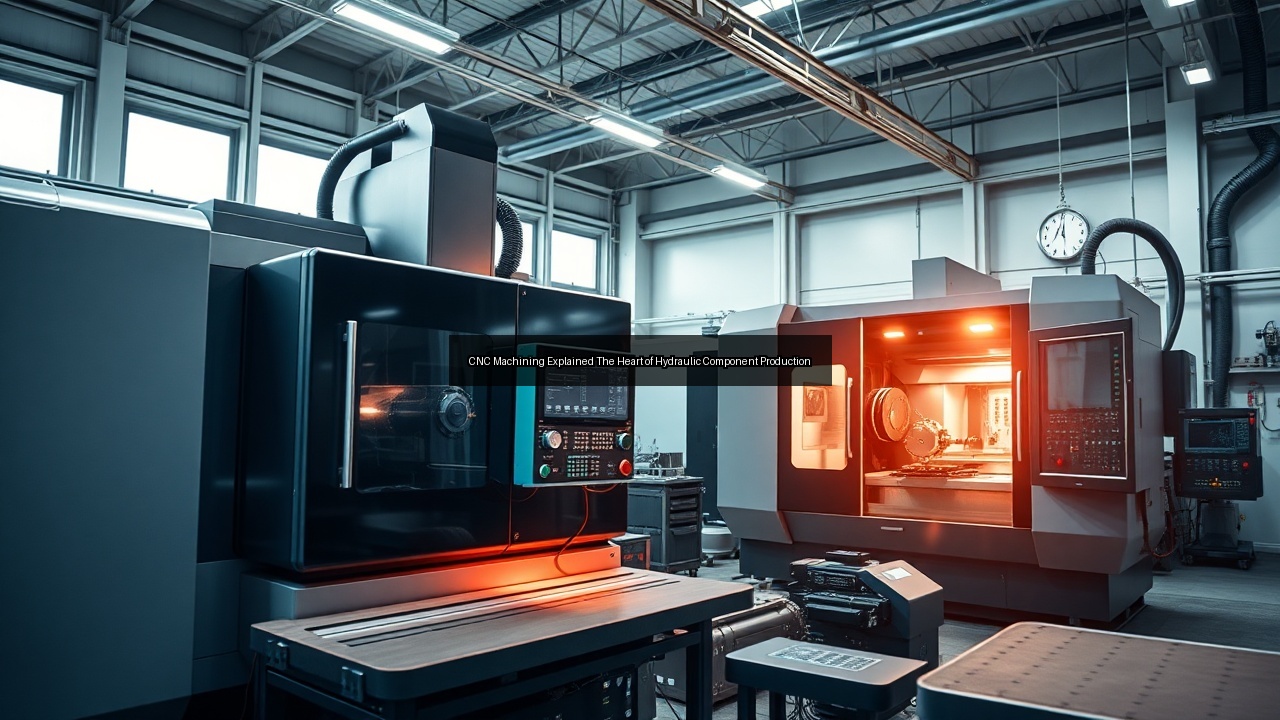
Understanding CNC Machining
What is CNC Machining?
CNC machining transforms raw materials into precision components through computer-controlled tools. Operators program machines to follow exact paths for cutting, drilling, and shaping. This process delivers consistent results across large production runs. In hydraulic systems, CNC machining creates parts that withstand high pressures and tight tolerances. Manufacturers rely on this technology to produce reliable hydraulic machined parts that keep equipment operating smoothly. The method eliminates human error common in manual operations and supports complex geometries required for modern hydraulics. CNC machining stands as the foundation for efficient hydraulic component production today.
At its core, CNC (Computer Numerical Control) machining relies on G-code instructions derived from CAD models to guide cutting tools along precise trajectories. In hydraulic applications, this means producing valve spools with concentricity tolerances as tight as 0.005 mm and cylinder barrels featuring honed internal surfaces that minimize fluid turbulence. The technology integrates seamlessly with CAM software, allowing simulation of tool paths before actual cutting begins. This pre-verification step prevents costly collisions and ensures optimal chip evacuation, especially important when machining tough alloys used in high-pressure hydraulic cylinders rated above 350 bar.
The Role of CNC in Manufacturing
CNC plays a central role in modern manufacturing by automating repetitive tasks while maintaining high accuracy. Factories use CNC systems to handle everything from initial material removal to final finishing. This automation boosts output rates and reduces waste. Hydraulic machined parts benefit directly because each valve body, piston, or cylinder meets strict specifications without variation. Manufacturers integrate CNC into workflows to shorten lead times and respond quickly to custom orders. The technology supports both prototype development and full-scale production runs essential for industries dependent on hydraulics.
Beyond basic automation, CNC systems enable real-time monitoring through sensors that track spindle load, vibration, and temperature. Data collected during the production of hydraulic manifolds can be analyzed to predict tool wear, allowing scheduled replacements before surface finish degrades on critical sealing lands. This predictive capability reduces unplanned downtime and supports just-in-time manufacturing models favored by fluid-power OEMs. Furthermore, CNC integration with ERP systems provides full traceability from raw bar stock to finished hydraulic machined parts, satisfying documentation requirements common in mobile equipment markets.
Types of CNC Machines Used in Hydraulic Parts Production
Production facilities employ several CNC machine types for hydraulic components. CNC lathes excel at turning cylindrical parts such as rods and fittings with rotational symmetry. Milling machines handle flat surfaces, slots, and intricate contours found in manifolds and housings. Multi-axis centers combine turning and milling in one setup to complete complex hydraulic machined parts without repositioning. These machines process metals like steel, aluminum, and specialized alloys used in high-pressure hydraulic systems. Selection depends on part geometry and required surface finishes.
Swiss-type lathes are increasingly employed for small-diameter hydraulic fittings and cartridge valve bodies, offering exceptional length-to-diameter ratios and live tooling for cross-drilling. Five-axis machining centers provide the freedom to create angled ports in pump housings without multiple setups, preserving datum integrity and improving positional accuracy. For larger components such as hydraulic cylinder tubes, horizontal boring mills equipped with CNC controls deliver deep-hole drilling and counterboring operations while maintaining straightness within 0.02 mm per meter. Each machine type is often paired with high-pressure coolant systems to manage heat generated when cutting stainless steels or precipitation-hardening alloys common in corrosive hydraulic environments.
The Importance of CNC Machining in Hydraulic Systems
How CNC Machining Enhances Hydraulic Efficiency
CNC machining improves hydraulic efficiency by creating components with precise internal passages and smooth surfaces. Reduced friction inside valves and cylinders allows fluid to flow with minimal energy loss. Tight tolerances prevent leaks that waste pressure and reduce system performance. Manufacturers achieve repeatable results across batches, ensuring every hydraulic machined part performs identically. This consistency translates into longer service life and lower maintenance costs for end users. CNC processes also support design optimizations that further increase flow rates and response times in hydraulic systems.
Precision-machined cross-drilled passages in directional control valves reduce pressure drop by up to 15 percent compared with cast equivalents, directly lowering pump energy consumption. Surface finishes of Ra 0.2 µm or better on spool bores minimize stick-slip phenomena, enabling smoother proportional valve operation. In addition, CNC-enabled design iterations allow engineers to incorporate flow-optimized geometries such as gradual radius transitions that suppress cavitation, extending component life in applications involving high-velocity fluid.
Key Features of Hydraulic Machined Parts
Hydraulic machined parts feature exact bore diameters, thread specifications, and sealing surfaces. CNC equipment produces these details with micron-level accuracy. Parts often include integrated ports and mounting features that simplify assembly. Materials receive proper heat treatment and surface treatments during machining to resist wear and corrosion. These characteristics matter in hydraulic systems where failure can halt entire operations. Quality hydraulic machined parts maintain pressure integrity under extreme conditions and contribute directly to overall system reliability.
Typical specifications include bore roundness within 2 µm, perpendicularity of mounting faces to 0.01 mm, and surface hardness values above 58 HRC after induction hardening of piston rods. Thread forms such as SAE O-ring boss or ISO 6149 are machined with controlled root radii to prevent stress risers under cyclic loading. Post-machining treatments like hard chrome plating, nitriding, or laser cladding are applied to critical wear surfaces, while passivation or anodizing protects aluminum manifolds in marine hydraulic circuits.
Applications of Machined Hydraulic Parts in Various Industries
Machined hydraulic parts appear across construction, agriculture, aerospace, and automotive sectors. Excavators depend on precisely machined cylinders to lift heavy loads. Agricultural equipment uses hydraulic valves for precise implement control. Aircraft landing gear systems rely on CNC-produced components for safety-critical performance. Automotive manufacturers incorporate hydraulic machined parts in braking and steering systems. Each industry demands different pressure ratings and environmental resistances, yet CNC machining adapts to meet these varied requirements effectively.
In offshore wind turbine pitch control systems, CNC-machined stainless-steel manifolds withstand 420 bar operating pressures and saline atmospheres. Mining equipment utilizes large-bore CNC-turned cylinder components capable of generating forces exceeding 2000 kN while resisting abrasive contamination. The medical sector employs miniature CNC-machined hydraulic actuators in surgical tables requiring positioning repeatability of 0.05 mm. Across all sectors, the ability to machine exotic alloys such as Inconel or titanium enables hydraulic solutions in extreme temperature or chemically aggressive environments.
Quality Assurance in CNC Machining
Standards and Certifications for Hydraulic Components
Hydraulic components must meet international standards such as ISO 9001 and specific industry certifications for pressure vessels. Manufacturers document material traceability and process controls to satisfy these requirements. Certifications verify that hydraulic machined parts undergo proper inspection at every production stage. Compliance ensures parts integrate safely into hydraulic systems operating in demanding environments. Companies pursuing these standards demonstrate commitment to consistent quality that customers in multiple sectors expect from a reliable hydraulic machined parts manufacturer.
Additional certifications frequently required include ISO 14001 for environmental management, IATF 16949 for automotive hydraulic components, and AS9100 for aerospace applications. Pressure Equipment Directive (PED) compliance and API 6A/16A standards govern parts destined for oil-and-gas hydraulic wellhead controls. Full material test reports (MTRs) and heat-treatment records accompany every batch, ensuring compliance with customer-specific PPAP or First Article Inspection (FAI) protocols.
Methods of Quality Control in CNC Manufacturing
Quality control begins with incoming material inspection and continues through in-process measurements using coordinate measuring machines. Operators verify critical dimensions after each machining operation. Final testing includes pressure checks and surface finish analysis. Statistical process control tracks variations and triggers adjustments before defects occur. These methods protect the integrity of hydraulic machined parts and reduce scrap rates. Thorough quality assurance builds customer confidence in the performance of finished hydraulic components.
Advanced facilities employ in-machine probing for closed-loop compensation of thermal drift during long production runs of hydraulic valve bodies. Laser scanning and white-light interferometry provide non-contact surface-finish verification on sealing grooves without risk of stylus damage. Functional testing under simulated load cycles—often exceeding 1 million cycles at 1.5× working pressure—validates fatigue performance before parts are released. SPC dashboards display real-time CpK values, prompting immediate tool-offset corrections when process capability drifts below 1.67.
Case Studies: Success Stories from Hogge Precision and McCormick Industries
Hogge Precision implemented advanced CNC lathe programming to produce high-volume hydraulic fittings with zero defects over multiple contracts. Their team reduced setup times while maintaining micron tolerances required for leak-free connections. McCormick Industries applied five-axis milling to create complex manifold blocks that improved flow efficiency in client hydraulic systems. Both companies documented significant reductions in warranty claims after adopting stricter in-process inspection protocols. These examples highlight how focused quality assurance delivers measurable gains in hydraulic machined parts reliability.
Hogge Precision further leveraged twin-spindle turning centers with robotic part handling to achieve 24-hour production of 5000+ SAE fittings weekly, cutting unit cost by 18 percent while sustaining 100 percent on-time delivery. McCormick Industries introduced adaptive machining strategies that automatically adjust feed rates based on real-time cutting-force feedback, reducing cycle time on aluminum manifolds by 22 percent and virtually eliminating chatter-induced surface defects that previously caused internal leakage.
FZE Manufacturing Solutions: A Leader in Hydraulic Machined Parts
Overview of FZE's CNC Machining Capabilities
FZE Manufacturing Solutions operates a full range of CNC equipment dedicated to hydraulic component production. Their facility includes multiple CNC lathes and milling centers capable of handling parts up to several feet in length. Engineers program machines for both standard and custom hydraulic machined parts. The company maintains in-house capabilities for milling, drilling, and threading operations required by hydraulic systems. This vertical integration allows tight control over schedules and quality throughout the manufacturing process.
FZE’s 45,000-square-foot climate-controlled shop houses 18 CNC machines, including 12 multi-axis turning centers and six 5-axis mills. Large-capacity horizontal machining centers accommodate ductile-iron valve blocks weighing up to 1200 kg, while micro-machining cells produce cartridge-valve components with 0.8 mm diameter cross-holes. In-house engineering teams utilize the latest version of Mastercam and Vericut to optimize tool paths, ensuring collision-free programs and minimal air-cutting time for every hydraulic machined part.
Innovations in Hydraulic Component Production
FZE Manufacturing Solutions introduced tooling strategies that extend tool life while achieving superior surface finishes on sealing surfaces. They developed custom fixturing systems that reduce cycle times for complex hydraulic manifolds. Recent investments in automation allow lights-out production of high-volume hydraulic machined parts without sacrificing accuracy. These innovations help clients achieve faster turnaround and lower per-unit costs while preserving the precision essential for reliable hydraulic performance.
Through the adoption of ceramic and cubic-boron-nitride inserts combined with high-pressure through-tool coolant at 100 bar, FZE extended tool life on hardened 4140 piston rods by 300 percent. Modular quick-change fixturing systems enable changeover between different manifold designs in under 15 minutes. Fully automated cells featuring collaborative robots and pallet changers now run unattended night shifts, delivering finished hydraulic machined parts with dimensional consistency verified by on-machine probing.
Partnerships and Collaborations in the Industry
FZE Manufacturing Solutions maintains long-term relationships with material suppliers and fluid power distributors. Collaborative projects with engineering firms have produced new hydraulic machined part designs that address specific pressure and flow challenges. The company participates in industry associations focused on hydraulics standards and best practices. These partnerships strengthen supply chains and keep FZE at the forefront of machining techniques used in hydraulic component manufacturing.
Joint development initiatives with leading pump manufacturers have yielded patented port geometries that reduce pressure ripple by 12 percent in axial-piston pumps. FZE also collaborates with university research labs on additive-subtractive hybrid manufacturing approaches, exploring the bonding of conformal cooling channels within hydraulic valve bodies. Active membership in the National Fluid Power Association ensures early awareness of emerging ISO and NFPA standards that influence future hydraulic machined parts specifications.
Choosing the Right Hydraulic Machined Parts Manufacturer
Key Considerations When Selecting a Manufacturer
Buyers should evaluate a hydraulic machined parts manufacturer based on equipment variety, quality systems, and proven experience with hydraulic applications. Lead time consistency, material sourcing transparency, and after-sales support also influence decisions. Facilities with integrated inspection equipment reduce risk of receiving out-of-spec parts. Companies that document process capabilities provide greater confidence when ordering critical components for hydraulic systems. Thorough vetting prevents costly production delays later.
Additional evaluation criteria include the availability of DFM (Design for Manufacturability) reviews, capacity for both low-volume prototypes and annual volumes exceeding 50,000 pieces, and cybersecurity protocols protecting customer CAD data. On-site audits should verify calibration status of all metrology equipment and review training records of CNC operators. Financial stability and insurance coverage for product liability further protect buyers sourcing safety-critical hydraulic components.
The Importance of Customization in Hydraulic Parts
Many hydraulic applications require non-standard dimensions or material grades. A capable manufacturer offers design assistance and rapid prototyping services. Customization ensures parts fit existing hydraulic systems without extensive modifications. CNC machining supports these tailored solutions efficiently because programs can be adjusted quickly. Partners that deliver both standard and custom hydraulic machined parts help customers optimize performance rather than compromise on available options.
Customization often involves modifying port thread types, integrating position-sensor mounting bosses, or specifying alternative coatings for extreme-temperature service. Rapid prototyping via CNC allows functional testing of new manifold designs within five business days, accelerating validation cycles. Manufacturers that maintain extensive raw-material inventories—including 17-4 PH stainless, 7075-T651 aluminum, and ductile iron—can respond to urgent custom orders without extended lead times.
Comparative Analysis of Leading Manufacturers: Hogge Precision vs. McCormick Industries
Hogge Precision focuses on high-volume turned hydraulic components with strong emphasis on thread quality and concentricity. McCormick Industries specializes in milled manifold blocks and housings requiring multi-axis operations. Both maintain robust quality assurance programs and serve overlapping industries. Hogge often leads in cost efficiency for cylindrical parts while McCormick excels at complex geometries. Selecting between them depends on specific part requirements and production volumes needed for each hydraulic machined parts project.
When projects demand ultra-high volumes of fittings and adapters, Hogge’s automated turning cells deliver lower per-piece pricing. Conversely, McCormick’s expertise in five-axis contouring and integrated flow-path optimization makes it the preferred choice for compact, high-performance manifolds where internal passage geometry directly influences system efficiency. Many OEMs maintain dual sourcing strategies, awarding turned components to Hogge and complex blocks to McCormick, thereby balancing cost, capability, and risk across their hydraulic machined parts supply base.